
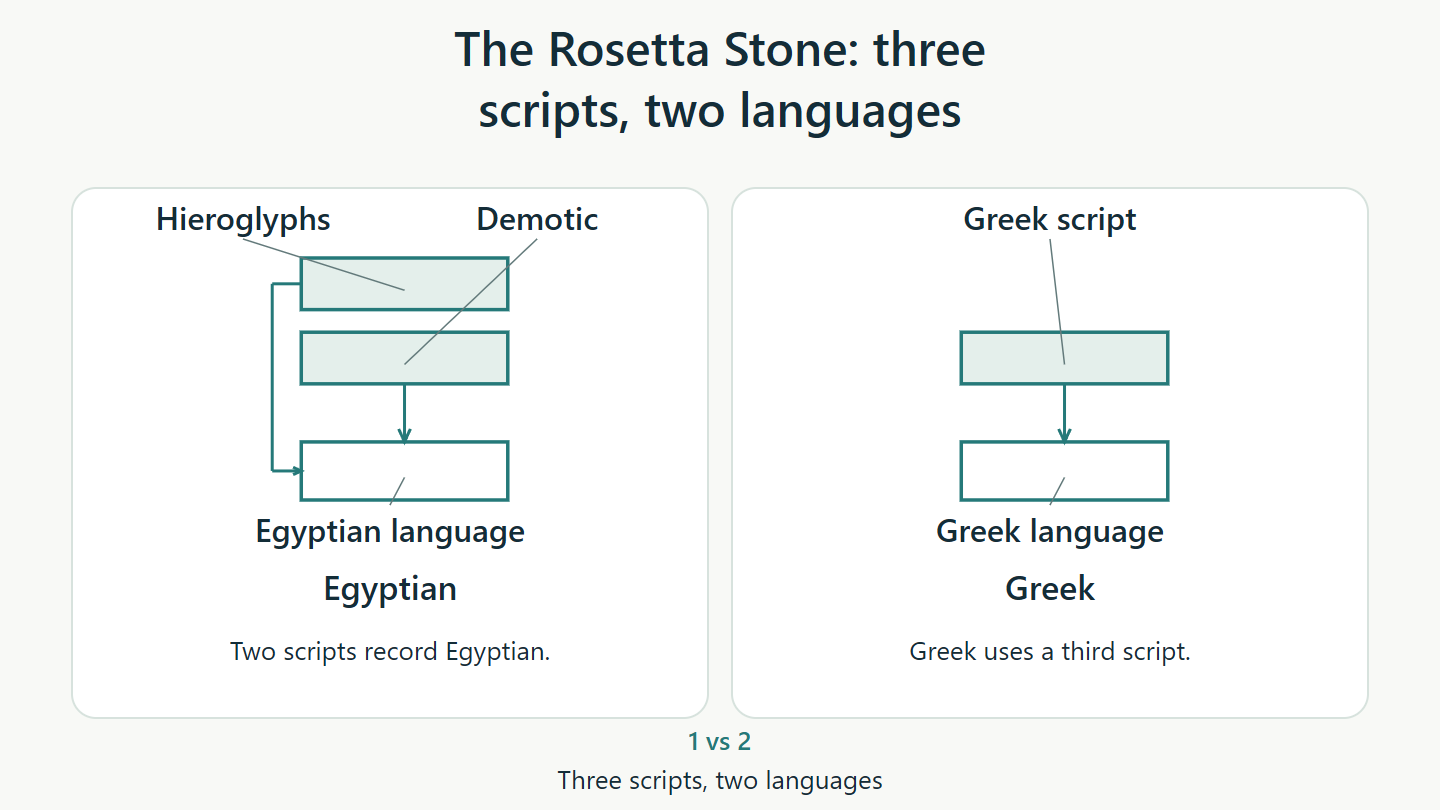
A script is a writing system, not a language. On the Rosetta Stone, readable Greek helped constrain possible readings of the Egyptian text.
Why a writing system is not the same as a language
Popular accounts often treat the decipherment of ancient writing as a sudden flash of insight sparked by a single artifact. In practice, breaking an unknown script works like a series of controlled experiments. Scholars form hypotheses by analyzing internal patterns, looking for proper names, and comparing parallel texts, and then they discard the guesses that fail. A proposed reading only becomes convincing when it can be applied to unexamined material and consistently produces sense beyond the single inscription that suggested it.
To understand how those tests work, it helps to separate two concepts that often get blurred together: a script and a language. A script is simply the visual system used to record speech, while the language is the underlying vocabulary and grammar. When investigators confront an unreadable inscription, they may be facing an unknown script concealing a known or related language, or a readable script recording an unknown tongue.
The Rosetta Stone, discovered in 1799, illustrates this distinction clearly. The stone carries three different scripts: Egyptian hieroglyphs, Demotic (a local Egyptian script read from right to left), and ancient Greek. Yet it records only two languages: Egyptian and Greek. Because nineteenth-century scholars could already read the ancient Greek section, they were not guessing at the stone in a vacuum. The Greek text provided a known body of content and historical names that constrained what the two Egyptian scripts above it could possibly say.
How names and parallel texts create a foothold
Even with a bilingual inscription acting as a crib, you cannot immediately match an unknown text word for word if you do not know how its signs operate. Proper names offer the best entry point because names generally have to be spelled out by sound even when moved across languages or scripts. On the Rosetta Stone, the British polymath Thomas Young noted in 1816 that certain framed clusters of hieroglyphs—known as cartouches—likely enclosed royal names. Because the Greek text referred to King Ptolemy, Young connected one particularly frequent cartouche in the hieroglyphs to a phonetic spelling of Ptolemy. The readable Greek supplied the candidate name, while the repeated cartouches gave scholars multiple instances to compare rather than an isolated drawing to guess at.
A single name, however, is not enough to prove how a script works. Scholars needed a cross-check, which arrived through another monument: the Philae obelisk, brought to England in 1821 by William John Bankes. The obelisk featured Egyptian hieroglyphs carved into its granite shaft and twenty lines of ancient Greek on its base. Bankes, Young, and others initially assumed the two inscriptions were direct translations of each other, just like the Rosetta Stone. In reality, they were not translations at all—the shaft carried a traditional honorific text for the royal family, whereas the Greek base recorded a petition from the priests of Isis at Philae and a royal grant of tax exemption.
Despite that mismatch in overall meaning, the Greek petition was addressed to King Ptolemy and two queens named Cleopatra (Cleopatra II and Cleopatra III). Because the same royal figures were named in both sections, Bankes was able to connect the Greek name Cleopatra to a specific cartouche in the hieroglyphs above. Meanwhile, in France, the linguist Jean-François Champollion had been studying a papyrus written in Demotic and Greek, comparing how Ptolemy was written in Demotic with the symbols making up the Ptolemy cartouche in hieroglyphs. Reversing those rules, Champollion constructed a theoretical hieroglyphic cartouche for Cleopatra—and when he received a lithograph of the Philae obelisk, his predicted sign sequence closely matched the cartouche carved on the monument.
Once scholars have two different names written in the same script, overlapping sounds lock the readings in place. Comparing the Ptolemy and Cleopatra cartouches allowed Champollion to test his predicted phonetic sequence against the Philae monument and use that confirmation to begin deciphering the phonetic values of other hieroglyphs. What unlocked the script was not one miraculous stone, but the way independent monuments constrained one another.
Reading signs, understanding a language, and reconstructing sound
Tracing how a script works also reveals why decipherment is not a single finish line. Identifying sign values, understanding the underlying language, and recovering how those words actually sounded are three distinct tasks.
First, recognizing how individual characters operate does not mean every sign works like a simple alphabet letter. For years, Young and Bankes assumed that Egyptian hieroglyphs were mostly logographs—one symbol standing for one whole word—and treated the phonetic spellings inside royal cartouches as a special exception invented solely to write foreign Greek names. Moving past that barrier required testing phonetic values across native texts and recognizing how a writing system combines phonetic signs with word-level symbols.
Second, even when scholars can sound out a script's signs, they still cannot translate the text unless they can work out the language's vocabulary and grammar. When the Linear B script of the Aegean Bronze Age was deciphered by Michael Ventris, the breakthrough held because transcribed signs consistently yielded recognizable early Greek words across newly examined tablets, confirming both the spelling rules and the grammar. By contrast, when an unreadable script records an unknown language with no known relatives, sounding out the signs does not hand over the meaning. As classicist John Chadwick noted, scholars can read the script of thousands of Etruscan funerary inscriptions, yet because those short texts repeat the same narrow formulas over and over, they provide only a very limited knowledge of the Etruscan language.
Third, translating an ancient sentence does not automatically recover its exact ancient pronunciation. When Chadwick presented transcriptions of Mycenaean Linear B tablets, he emphasized that reconstructing the actual spoken sounds a scribe would have heard remained largely conjectural, and even translations often allowed alternative renderings. In ancient Egypt, reconstructing sound relies heavily on Coptic—the latest stage of the Egyptian language, written from the third century AD onward using the Greek alphabet supplemented by several signs from Demotic. Because Coptic writes out vowels as well as consonants, it is phonologically the most transparent stage of Egyptian.
As Egyptologist James P. Allen demonstrates, linguists deduce the sound values of Coptic characters by comparing how words alternate across six major Coptic dialects and how Egyptian words and place-names were rendered in Greek, Hebrew, or Arabic. For example, matching the Coptic place-name šmoun to Arabic ašmūn helps confirm a 'sh' sound, while comparing Greek loanwords and Classical versus Koine Greek values reveals how scribes preserved older pronunciations even as spoken Greek changed. These cross-language clues place tight boundaries around ancient phonology, even though no modern reconstruction can guarantee every nuance of living speech.
Why some ancient scripts remain undeciphered
Because decipherment depends on cross-checking hypotheses against independent constraints, the process stalls when the surviving evidence is too thin. As Chadwick observed, the success of any decipherment depends first on having adequate material. When a bilingual crib exists, even a relatively short text can supply enough anchors to interpret the rest of a corpus. Without a bilingual inscription, a far larger volume of text is required to chart sign frequencies, isolate grammatical endings, and build an internal grid of how signs alternate.
If the surviving inscriptions are too few, too fragmentary, or locked into a single repetitive genre like brief gravestones or ownership labels, scholars lack the virgin material needed to test competing theories. And if the underlying language has no known descendants or relatives—a hurdle that long complicated work on Aegean scripts like Linear A and Cypro-Minoan even after Linear B was solved—plugging in approximate sound values fails to produce recognizable words. When an ancient script remains unread today, it is rarely for lack of cleverness; it is because not enough independent constraints survive to prove that one reading is right and all the others are wrong.