
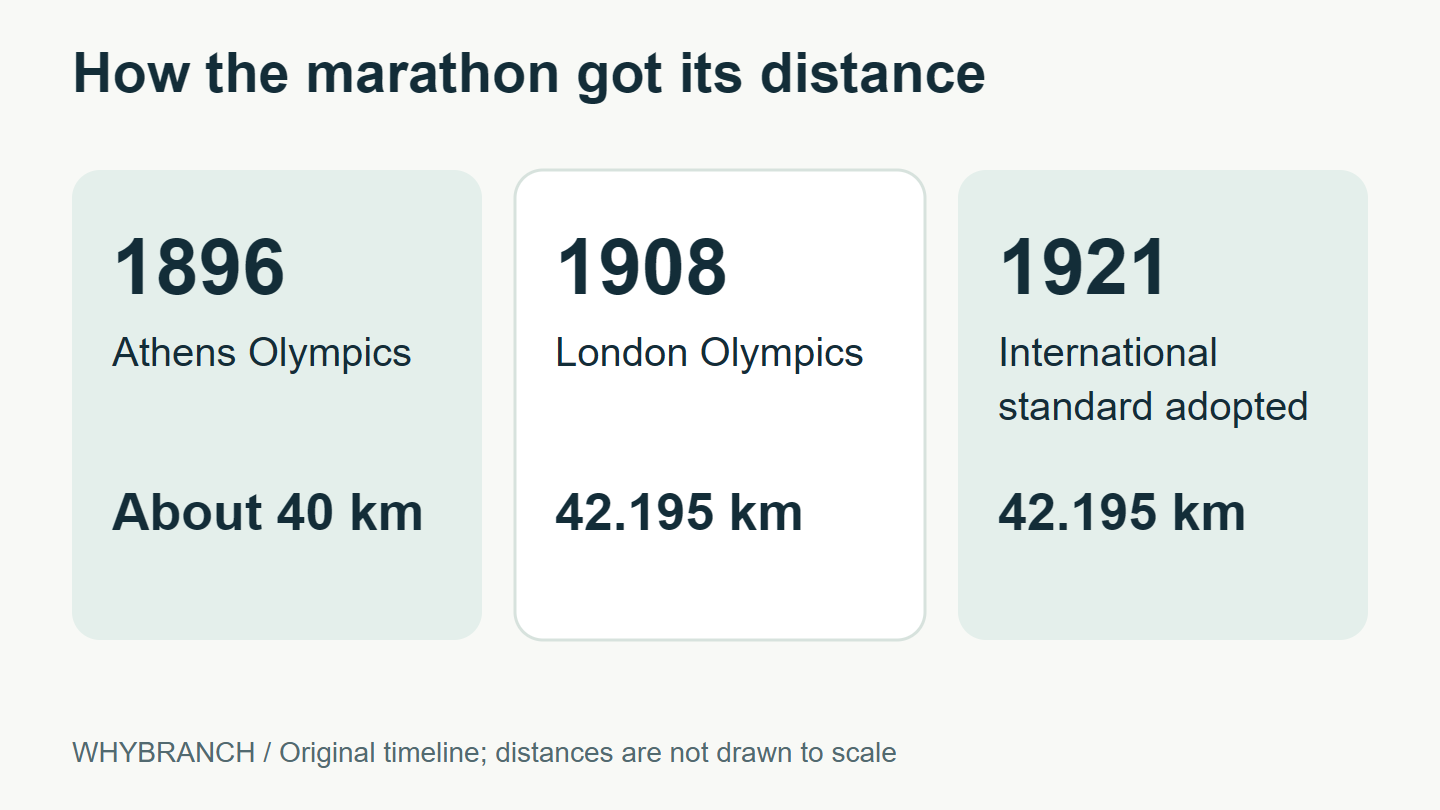
A marathon is 42.195 kilometers, usually rounded to 26.2 miles, because the distance used for the 1908 London Olympic race later became the international standard. The governing athletics federation adopted it in 1921. Earlier Olympic marathons had used different distances.
The unusual number comes from the history of a particular modern course. It wasn’t a precise measurement handed down from an ancient Greek race.
The first Olympic marathon was shorter
The marathon entered the modern Olympics at Athens in 1896. Its organizers devised a race of about 40 kilometers, inspired by the story of a messenger running from Marathon to Athens.
World Athletics describes that origin as a legend. It explains the event’s name and inspiration, but it doesn’t establish today’s exact course length. Early organizers still had to choose routes and distances for their own races.
London’s 1908 course supplied the number
In London, the race began at Windsor Castle and finished at White City Stadium. The finish was in front of the royal box. The course was recorded as 26 miles and 385 yards—the distance associated with today’s 42.195-kilometer marathon.
The royal setting has helped a memorable story spread: that the extra distance was simply added so the royal children could watch from their nursery. That detail deserves more caution than it usually gets.
The nursery-window story is disputed
Olympedia’s researched account of the 1908 race explicitly corrects the nursery explanation. It cites historian Bob Wilcock’s work and contemporary reports of organizers seeking permission to start at Windsor, rather than a royal request to extend the course for that view.
Wilcock’s study of the 1908 marathon also warns that familiar explanations are contradictory or incomplete. The documented start, finish, and recorded distance are firmer ground than a neat story assigning the whole decision to one royal preference.
It became a standard in 1921
Using the distance once didn’t instantly make it universal. The 1921 decision by the International Amateur Athletic Federation, now World Athletics, was the step that established it as the standard. Olympedia records its use again at the Olympics from 1924.
Why you usually see “26.2 miles”
The familiar mile figure is rounded. A distance of 26 miles and 385 yards is about 26.219 miles, which becomes 26.2 when rounded to one decimal place. The standard marathon length is stated more precisely as 42.195 kilometers.
Sources and illustration
World Athletics supplies the standard distance and timeline; Olympedia and Wilcock’s historical research help distinguish the recorded course from later stories about it. The original Whybranch timeline is an illustration, not a reproduction of a historical map.