
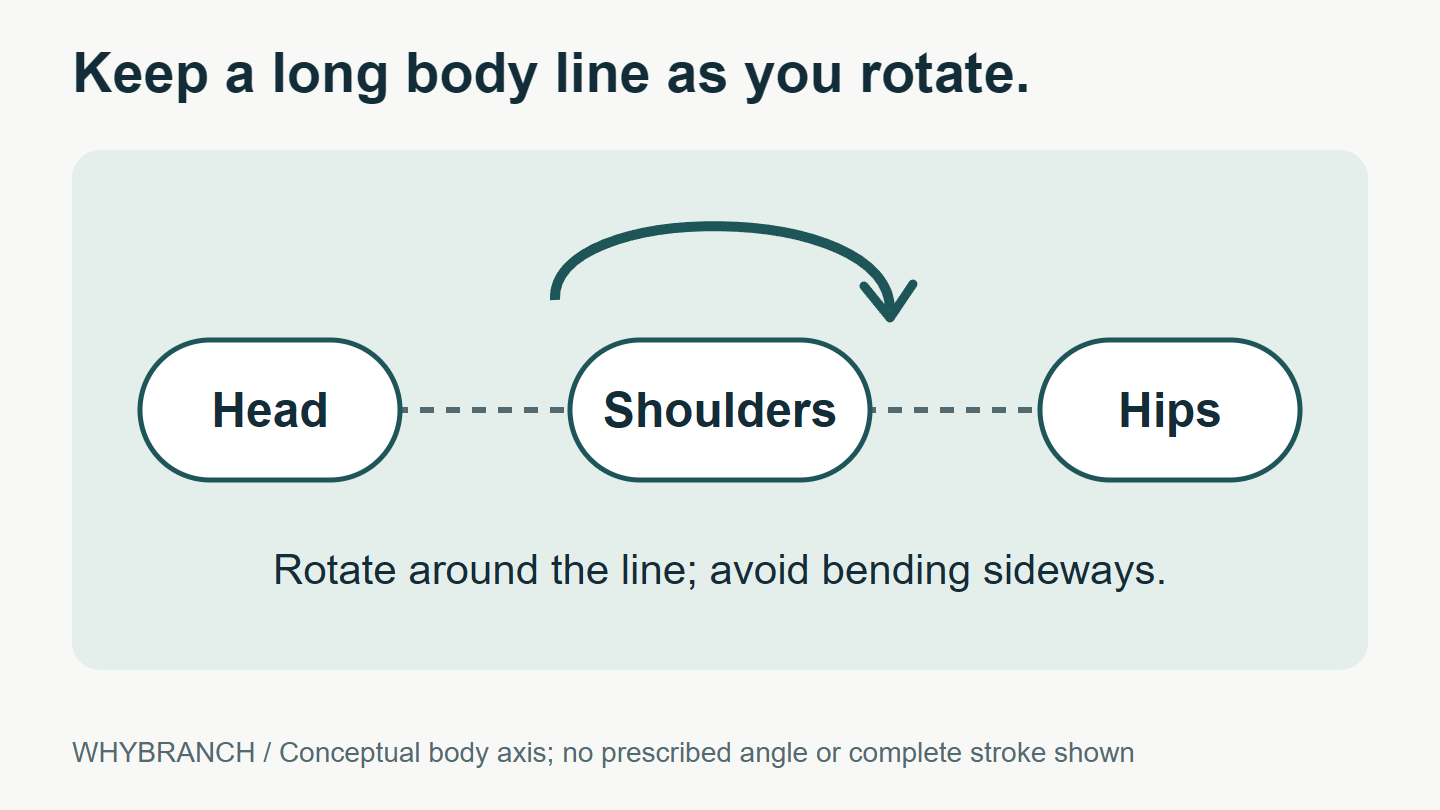
A balanced freestyle position keeps your head, torso, and hips aligned while your body rotates through the stroke. Your hips stay near the surface rather than trailing far below your chest. A relaxed head position helps; trying to hold your whole body rigid and perfectly flat can make breathing and arm recovery harder.
Here, freestyle means front crawl. These are position cues for swimmers who can already swim comfortably in a supervised pool, rather than a first lesson in floating or water safety.
Start with your head and neck
Look generally down toward the pool floor, or slightly ahead, while keeping your neck in line with your spine. Holding your face forward to watch the far wall can change the balance of the rest of your body.
As U.S. Masters Swimming explains, lifting the head tends to let the hips sink. A harder kick may then be doing extra work to support that position. Tucking your chin tightly against your chest is another extreme; a neutral, relaxed position is the more useful starting point.
Watch the line through your hips
When your legs hang well below your upper body, more of your body sits across the direction you’re trying to travel. Improving alignment reduces that obstacle. Think about the line through your body, rather than trying to force your feet out of the water.
Your lungs help support the chest, but your body doesn’t float as a uniform object. Body proportions and buoyancy differ between swimmers, so one exact head angle or pressure cue won’t suit everyone. The useful question is whether a small adjustment helps your hips stay supported without adding neck tension.
Aligned doesn’t mean motionless
Front crawl includes rotation around the long line of your body. Your shoulders and hips turn as the arms alternate. That rotation is different from bending your torso sideways or swinging your legs across the lane.
Keeping your chest locked flat against the water can leave you trying to create room for the recovering arm or a breath with your neck alone. Let the body turn while keeping its overall line long. The amount of rotation varies with the swimmer and the stroke; there isn’t one angle to copy from a still image.
Notice what changes when you breathe
If your position feels settled between breaths but falls apart whenever you inhale, watch the head movement. Lifting forward or pulling far out to the side can disturb your alignment.
The USMS breathing guide connects taking a breath with body rotation. Turn with that movement instead of trying to raise your whole head clear of the water. Keep breathing normally through your swim; holding your breath isn’t a way to maintain body position.
A coach watching a short, comfortable swim can help you separate a head-position issue from a rotation or timing issue. Ask them to watch your hips and body line as you breathe. That feedback is more specific than trying to correct every part of the stroke at once.
Sources and illustration
The linked USMS coaching guides cover head position, alignment, rotation, and breathing. The original Whybranch illustration shows a body axis and rotation conceptually. It does not prescribe a measured angle or show a complete stroke sequence.